

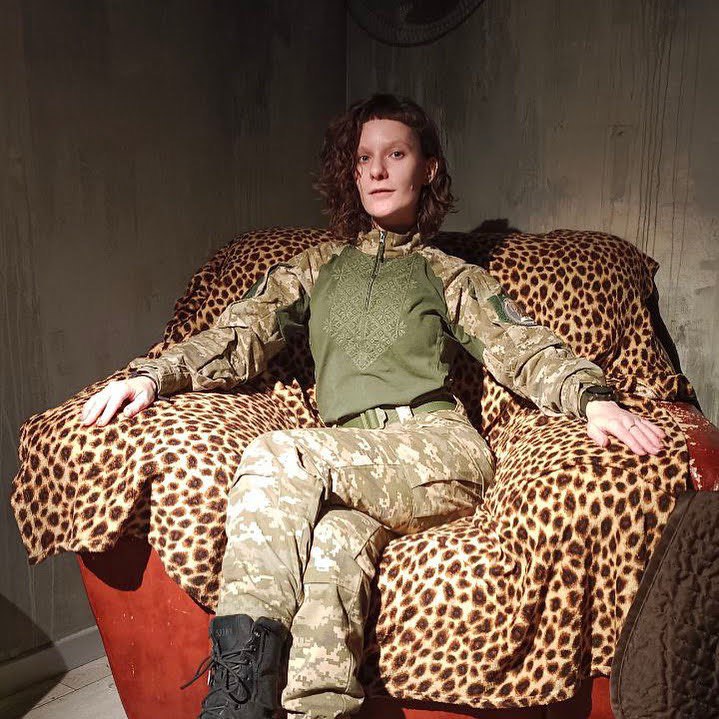
I grew up in a creative environment and always felt that I was attracted not only to boys. But because of cultural norms, I never really saw it as a real possibility to have relationships outside the heteronormative framework. I wasn’t involved in any political movements until 2013, when Euromaidan began. That was the first time I realized that you have to fight for your rights, even when it’s scary. Until 2016, I had no idea there was an actual LGBTQI+ movement in Ukraine or what it was doing — until I was invited to our queer home in Kharkiv. It was a project for feminist and LGBTQI+ initiatives, and through it I learned about volunteering as part of the security team at KyivPride 2016.
Actually, that was the very first time I became part of the queer community. It was such an interesting experience, because before that I imagined queer activism as, you know, everyone sitting on beanbags, drinking coffee, giving each other compliments — and that was basically the whole community, the whole activism. Seriously, that’s how I pictured it in my head.
I didn’t really understand the problems society was facing, and I also didn’t take my own queerness very seriously. But here, we were gathering for something… I don’t even know how to put it… proactive, brave. And it was super scary, because before that no one had ever organized volunteer security at Pride. This Pride was massive, the first of its kind. On Pride day, I was literally walking there on shaking legs. It was terrifying.
After that, I started taking on more and more responsibility, because I had experience in teaching and public speaking — which really helps when working with volunteers. Additionally, back then, security volunteering was mostly organized by people from Kharkiv.
And that’s how it went on until 2022. In 2020, I went to study in Belgium, then traveled a bit. And by 2022, when “the full-scale invasion” began, I had to make a choice. I returned to Ukraine and started volunteering — first in Lviv, then in Kharkiv. But soon I realized that volunteering wasn’t enough for me — I needed to get involved in something bigger.
What did you study abroad?
My field is zoology, and specifically my specialization was bats. Yep. My callsign is Kazhjan (translates to “bat” in Ukrainian). So, yeah, it’s all coming together. I already had a bachelor’s in molecular biology and biotechnology, and then a master’s in vertebrate zoology, which I completed in 2015. When the full-scale war began and I saw how the academic community was reacting, I realized I just couldn’t stay among them.
How did they react?
I was enrolled in a program in tropical ecology and biodiversity. It was quite a mobile program — every semester I moved to a different location. The first semester was in Brussels, the second on Réunion Island in the Indian Ocean, the third in Florence, Italy, and the fourth was dedicated to thesis work with my supervisor, who worked at the Ghent Museum (Belgium).
These were very progressive, very empathetic people. Biologists, in general, love all living things — they’re not dry or overly formal. But there’s also another side to it. They all want to be humanists, to stand on the right side of history. And yet, in reality, they don’t actually make a choice. I organized one event at my university — by the way, it turned out to be quite a good one. I teamed up with another Ukrainian from international communications. He began with a lecture about how Russia has been against Ukraine for centuries. He gave a brief overview of the history — from the times of Kyivan Rus and Muscovy, how everything developed, why Russia kept pressing us, and how today’s war is, in a way, just the logical continuation of Russia’s imperial nature.
After that, I shared my own experience, explaining that I was studying at their department — back then it was the Department of Mycology. I explained that in fact the war had already begun in 2014. Where exactly? When Ukrainians on Maidan were defending their right to a democratic society and state. That’s what Russia didn’t like, and that’s when it started pressuring us.
I was a participant in Maidan myself. In fact, I first came to Kyiv on February 20th — the very day of the largest mass shootings on Instytutska Street. That is my personal story and my trauma. I had real PTSD, which I didn’t fully realize until 2020, when the events in Belarus began. That’s when I experienced retraumatization and understood that my reaction wasn’t very healthy. I turned first to a psychotherapist, then to a psychiatrist. I was diagnosed, prescribed antidepressants, and so on. So for me, this whole story really begins in 2014.
At that event we also screened Winter on Fire — the best-known and most accessible film about Maidan, available on Netflix. It made a strong impression on people. We managed to raise about 400 euros and sent it to Ukraine. I later tried to organize a similar event, but on a larger scale — at the level of the whole university. That time it didn’t work out: people started saying things like, “it’s inconvenient,” “how will this look,” “is it really worth it,” and so on.
I remember one of the last straws for me was a letter from a foundation called Help Ukraine. In the letter they wrote that they were helping Ukrainians, Russians, and Belarusians. And I thought: for fuck’s sake, if you want to help Russians and Belarusians so much, then set up a separate fund — Help Russia, damn it, and Help Belarus. Why are you putting that under the name Help Ukraine? These were the kinds of things that frustrated me terribly. So I realized I couldn’t stay among them. At first, I went to Lviv. Though, to be honest, I was lying to myself a little at that point — I kept saying I was only going for a couple of weeks, just to reconnect with friends. I felt that my friends who had fled Kharkiv under shelling were traumatized in a completely different way than I was, sitting abroad. And that we wouldn’t be able, so to speak, to tune in to each other.
World War III and Pacifism
Honestly, it’s easier to live without expectations. Especially without the expectation that everything will return to some kind of “normality.” It won’t. We’re already living in a new world, and the truth is, we’re already in World War III. It just started here with us, and it’s already affecting the entire world. We’ve already had North Koreans fighting us. China is talking about “peacekeepers”. All of this is influencing how the armed forces of every country will operate because, right now, nothing is more deadly than FPV drones. On the battlefield, I mean. And who knows how to operate them? Ukrainians and Russians. All the other countries, of course, are scrambling to learn this technology. Once this war ends, they’ll be taking our people to learn from them.
Unfortunately, the world is becoming less safe than it has been in the last few decades. And if you look at history, a period of relative peace like this was only a brief blip in the 20th century. Humans are intelligent, but we’re also incredibly aggressive. We wiped out the Neanderthals who lived alongside us because we were more aggressive. And, unfortunately, our intelligence tends to push us in the direction of inventing more and more effective ways to annihilate each other.
But there’s a problem: “pacifism”, like the kind that’s still embraced by the queer community, for example, in the EU — that’s a certain kind of privilege. I often say this and emphasize it. Because let’s imagine a situation: if I get captured now, what will happen to me in captivity? I think the fact that I’m an LGBTQI+ activist won’t exactly make me safer in Russian captivity or under Russian occupation. We know the brutally negative attitude toward the LGBTQI+ community in Russia — both in terms of public discourse and the laws they’ve passed.
For me, the boundary of safety in this new world is pretty clear. I cannot be conquered by Russia, the Russian Empire, the Russian Federation. That’s why I’m on the side that’s doing everything possible to resist the Russian army. I really don’t have a choice. My city is right on the border with Russia. It’s under fire every day, people die every day, businesses can’t develop properly, communities can’t grow, and so on. It hurts me, I don’t like it. That’s why I’m in the army. Simple as that. Therefore, I can’t maintain pacifist views, because in this situation, they simply don’t work. It’s like a child hiding behind a storm and saying, “I’m not here, you can’t see me.” I can sit with my pacifist views in my apartment in Kharkiv, and a shell could drop on top of me, and I’ll be dead.
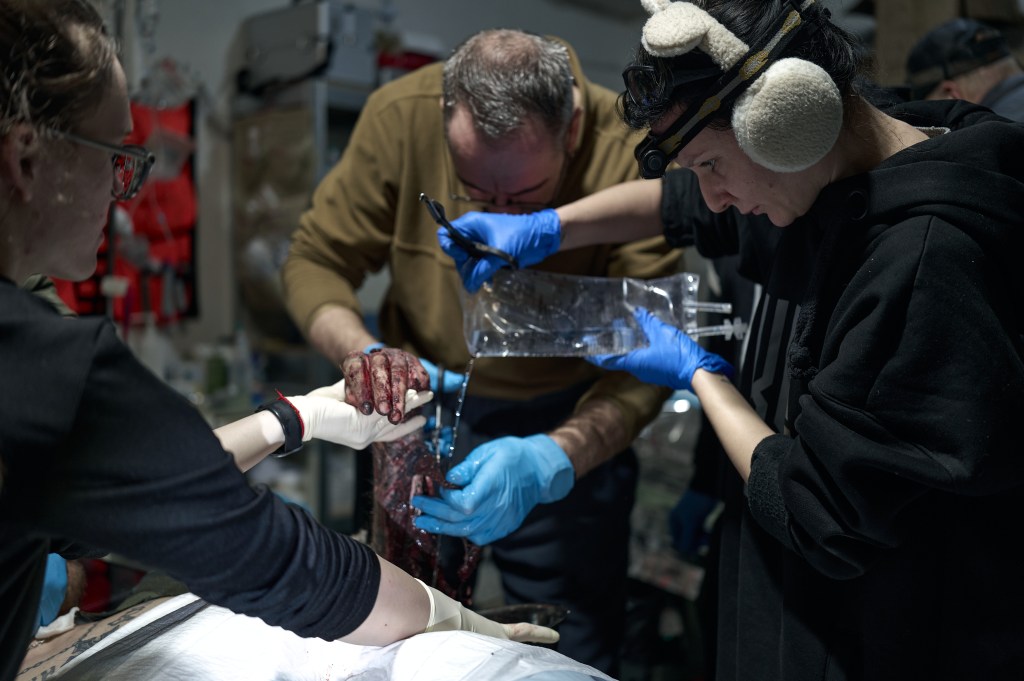
photo: Liberovy
How are my pacifist views supposed to help me in this situation? The pacifist views that many people in the EU share right now kind of give off this victim-blaming vibe, honestly. There’s this cognitive distortion called the “just-world hypothesis.” Why is it a cognitive distortion? Because our minds just can’t properly accept the fact that we don’t control the evil that can happen to us. For example, when we talk about victim-blaming regarding people who have experienced sexual violence, it’s easier for us to think: “It happened because of their clothes, the time they were out on the street, or their behavior.” And, in fact, if we do the opposite — if we don’t walk down those streets, dress differently, and control our behavior — we think nothing will happen to us. Our brains want to believe this. This is called the “just-world hypothesis.” Pacifism works in a similar way. If I’m “white and fluffy,” if I’m a hippie, if I’m a “flower child,” if I’m a citizen of peace, if I’m a pacifist — then that means no one will come and strike me with a shell, no one will use FPV drones on me, no one will rape me, my wife, or my child and leave us to die with slit throats. Good morning. Unfortunately, that’s not how the world works.
In the army
I even thought at some point that in Lviv I would start having panic attacks from the air raid sirens. Abroad I felt so horribly, so ultra… ultra fragile. But as it turned out, it wasn’t quite like that. When I came back to Ukraine and was among people who were suffering just as much as I was, I gradually began to recover, to adapt, to gather strength, and — so to speak — to believe in myself again. I felt I could keep pushing those inner boundaries further. In fact, I returned to Ukraine to find myself in this war. To understand where my “mission” was, where I could bring myself together as much as possible in order to serve, to function, and not fall back into despair. And what I’ve been doing in the army for almost three years now — going into the fourth — is precisely the answer to that.
I imagined that once I joined the army, there would be many strong women, and that they’d all be from the community — because really, what other women would join the army? It seemed obvious to me: either lesbians or bisexual women. That was the stereotype in my head, and honestly, it’s a stereotype in society too. After all, when a woman goes into the army, people always assume that something is “wrong” with her: either she’s looking for a man, or she’s a lesbian, or she needs to prove herself through some “masculine behavior.” But in reality, under the conditions of full-scale war, very different people come to the army. Some volunteer, others don’t. There are people in their fifties and others who are very young. What unites us is one thing: the will to resist Russian aggression. That makes it possible to find common ground, to share everyday life, and to work together.
Yet the moment you try to go a little deeper, to build closer connections, you realize that everyone’s experiences and motivations are so different that true intimacy — the kind you have in civilian life — just isn’t possible here. It’s only possible if you knew each other before the army, as civilians, and then this military experience layers itself onto something you already shared. This phenomenon of brotherhood and sisterhood is really about shared everyday life. People can spend 24 hours a day together: sleeping in the same room, eating from the same bowl, taking showers, doing laundry, bathing, riding in the same car. You tune into each other on this practical, day-to-day level. But you rarely form deeper, more intimate relationships. Because true closeness is only possible when there is a choice — to move closer, or to step away if you need space from someone. Here, that choice doesn’t exist — you’re always at the same distance.
For a period of time, you are with someone very closely, and you connect on a basic level. And because of that, these people later find it easier to accept your differences. I’m speaking now from my experience in LGBTQI+ activism — about the fact that I’ve had girlfriends, and maybe I’ll have girlfriends again someday.
photo: Anton Shevelyov
And that’s valuable, because at first you accept a person almost unconditionally. Then later you can learn things about them that, in civilian life, you would probably never have found out. Some of the people I serve with first got to know me as a soldier, someone performing certain functions. And then they were like: “Oh, and you’re also…” Sometimes that becomes a starting point for more detailed conversations. Not all of these conversations are serious. Often they’re on the level of, “So, what’s it like with girls?” — people are curious even about the physical side, about how that’s possible. For my part, I don’t want LGBTQI+ activism to be the central theme of my work right now. Because, honestly, it takes a lot of resources.
And that’s when it really hit me — even the people closest to you often have no idea how hard this actually is.
Veterans
Honestly, in Ukraine right now, the status of being a veteran — having combatant status, a veteran’s ID, whatever — only really means something in more “civilized” places and institutions. You know, the kind where the people more or less share your values. But like, some random dude on the street — a draft dodger — he doesn’t care if you’ve got a veteran’s ID or not. He’ll always find a thousand reasons not to respect you. I’ve even had moments when some of my closest friends — people I’m like 99.9% aligned with in terms of values — didn’t quite realize when they should’ve just shut the fuck up. Like this winter, I was in Lviv, hanging out with friends, and we were talking about all sorts of stuff. At some point, one girl goes, “I feel so bad for the guys I know who are hiding from the draft office and won’t even leave their apartments.”
And I’m just sitting there thinking, wait, what? why exactly am I supposed to feel bad for them? I tried to explain gently, saying that if they don’t want to join the infantry, they can go to a recruitment center, inquire about available positions, sign a contract, and then undergo training to get the position they want. And she goes, “Oh no, that’s too hard right now. It’s easy for you to say — you volunteered.” And I’m like… how can someone even say that to my face? I mean, sure, I can admit that in 2022 it was “easier” to join the army — there was this huge wave of unity and adrenaline, and people were coming together. But it’s been three years since 2022. I’ve lived through enough stuff to fill several lifetimes. And you’re gonna tell me it was easy?
Then I just got up and went to another room — lay down on the couch — and thought: “Okay, I can’t keep having this conversation without getting aggressive, so I’m just gonna step away.” She came in to apologize, but even in her apology, she started saying more nonsense. And that’s when it really hit me — even the people closest to you often have no idea how hard this actually is. That’s why I’ve never had any illusions about society carrying me around on their shoulders or treating me like a hero. I came into all this through feminism. I’d read Alexievich’s book The Unwomanly Face of War — it’s brutal, honest, and deeply disturbing. It’s about women who served during World War II, or just lived through it. When they came back from the front, their own families kicked them out — “You were in the army, you’ve ruined your reputation.” Even the wives of veterans treated them like garbage — like, “You were out there messing with our husbands.” The experiences of World War II veterans — especially women, but not only women — show just how cruel society can be. Veterans with disabilities were literally sent off to places like Valaam so no one would have to look at them. Later, I read about the U.S., about the Great Depression — how they used military force to break up protest camps full of veterans who were just asking for the compensation they were promised.
On Demobilization
For a long time, I just couldn’t imagine what life would be like after I got demobilized. On the one hand, I was so done with everything — I just wanted to get away, even if just for a day. But on the other hand, the idea of going back to civilian life honestly terrified me. Because you know that out there, you’ll be surrounded by people who don’t share your values. Like — you were fighting, and they weren’t. And suddenly, it’s like you’re a fish dropped into a new tank, surrounded by unfamiliar fish who act in weird ways. There’ll be issues — with addiction, for example. Alcohol, gaming, drugs — people will try to numb the discomfort however they can. And there’s also this other problem: a lot of people in the army didn’t grow in their civilian professions — they regressed. Some of them won’t be able to go back to the jobs they used to do. It’s not an easy transition. It’s a real test.
So what helped me? I started actively thinking, imagining, dreaming. I remembered this idea I had even before the army — to bring all of my experiences together into something meaningful. I want to work on mental recovery projects for veterans — through scientific volunteering in national parks, museums, botanical gardens, and so on. I want to take my past experience working with youth nature groups and basically create nature clubs for adult veterans. These kinds of programs already exist in places like the U.S., France, the UK, and others. And this is exactly what I want to do — help people recover by being in nature, observing natural processes, while also contributing to science and conservation. It’s deeply meaningful work — both morally and practically. That’s the kind of thinking that keeps me going. And I’m already planning to launch a pilot project next year. Right now, I’m in the process of consultations and networking. I’m looking at two national parks as potential sites. In September, I’ll be talking to a friend of mine who already works in this space.
Registered civil partnership for LGBTQI+
Our Ukrainian leadership, in times of war, will avoid making any decisions that could be seen as unpopular. For instance, the legalization of civil partnerships could be perceived as an unpopular decision among homophobic people, because they are directly associated with the LGBTQI+ community. And that’s why such decisions are not made. I feel that any progressive human rights agendas in our country are usually adopted in exchange for something from the EU, where these values are key. I’ve even heard that the civil partnership law is not being passed so that Islamic states don’t stop supporting us. It could be that it’s being used as a bargaining chip for certain things. When we got the visa-free regime, that’s when the first major Pride took place, which was organized by the efforts of many people, including with the support of Khatia Dekanoidze, who was then the Minister of Internal Affairs. There was an insane amount of police and internal troops involved. It wasn’t just a coincidence. Not because we’re so smart and beautiful, but because it was traded for certain concessions from the countries that made those concessions to us.
And as long as we can’t, so to speak, exchange civil partnerships for ten Patriot missile systems, no one will make such an offer, and our government won’t move on that issue. The only thing I can say is that certain things can actually be formalized through a notary in terms of mutual responsibility. But that’s not the same as official state recognition in the way we want for our relationships. It’s not social or political recognition in its full sense. Yes, we want full partnerships, marriages, and so on. But if we want to build and develop our communities and our democratic state, first and foremost, we need to have that state. I mean, we can’t turn into Ukrainians whose government operates in exile. Right now, our government works from Kyiv, Ukrainians live in Ukraine, mostly. Of course, some people have left the country, but they are a minority, and sooner or later, they’ll want to return. We don’t exist as a virtual state, but as a real one. And in order to change things for the better, we need to keep it intact. Civil activism should be carried out by those who can’t serve in the army. For me, it’s very clear: if I can serve in the army and my health allows, I serve. When my health no longer allows for any reason, I’ll return to civil activism.
 Queer War Archive