


I’m from Avdiivka, a small town in Donetsk region – about 40,000 people at most, so everyone knew everyone. I’m lesbian. I realized I liked girls when I was about 8, and by the time I was 10, I was sure. It felt strange, because I thought I was “supposed” to like boys, but I was drawn to my girlfriends.
There were some random unpleasant encounters with drunk people, but no mass aggression, not even among teenagers. Back then there were no real social networks, maybe just ICQ.
At school, I never really faced any hate. By 9th grade I was already giving flowers to girls from other classes, even older ones, and people were fine with it. Nobody bullied me.
In 2014, I was studying at Donetsk University. First, I did an internship, and later I worked at an independent news outlet. At that time, it was the only independent one in the city – everything else was controlled either by Rinat Akhmetov, the city council, or the Party of Regions.
Later, I moved to Kyiv and became even more socially active. I started working at an LGBTQI+ rights organization, where we also ran a media project. That was when I started going to protests. Before that, the only protests I’d attended were in Donetsk, against Russia.
Everything felt fine, no one was really oppressing us. Back in 11th grade, I never even thought about things like laws, civil unions, or marriage for LGBTQI people. It all felt like something from another world. Honestly, it still feels that way today.

Mariupol
In 2022 I joined the army. I’ve lived almost my whole life in Donetsk region — only four years in Kyiv. In 2019 I moved to Mariupol and stayed there until 2022. For some reason, all of us — me and my friends — were drawn there. We built quite a big community of displaced people in Mariupol. I love Donetsk region deeply — it’s my home, my steppe. I knew I could handle a lot of things, so I thought: I can handle this too. At first, I wanted to join a combat unit. And I did, but later our unit was disbanded, and I ended up in the rear service of a very well-known brigade. I argued with pretty much everyone there. Now I serve in another brigade as a drone pilot — doing reconnaissance and dropping munitions.
– Were you in Mariupol at the start of the war?
– Yes, I was there until March 17. On the first day of the invasion, my friends got together in the morning and left. They even offered us seats in the car. But it was me and my then-girlfriend… Her mom didn’t want to leave that first day, so we stayed. Almost all of our people left either that day, or a couple of days earlier when Putin recognized the so-called “DNR” as part of Russia. That’s when everyone started packing.
But I already knew what to do – I had lived through all of this back in 2014. That year, every independent newsroom in Donetsk had to leave. It all really started in Sloviansk – the armed confrontation. Then Girkin showed up in Donetsk with artillery and tanks. Before that, all the state institutions there were basically paralyzed. Even the state treasury wasn’t working.
I stayed in Donetsk for about three months after most people had left. I kept studying, taking exams, going to protests. And when they blew up the Putylivskyi bridge between Donetsk and Avdiivka, that was my last day in Donetsk. After that I stayed in Avdiivka until August 1st, because back in 2014 the city was occupied for almost three months. When the Ukrainian flag was raised over the city council, I packed my things and left for Kyiv.
By then I felt calmer – but it wasn’t the place I wanted to live anymore. Before 2014, I had never even thought of moving. I liked living in Avdiivka, and studying and working in Donetsk.
In Mariupol, I basically knew what to expect. My friends and I had talked about it — the front line was really close. Plus, there had already been an attack in the Sviatochny neighborhood in 2015 or 2016, when residential buildings were hit by Grad rockets. So it was clear: if Mariupol was attacked, they’d slowly destroy everything with artillery.
I withdrew money from the ATM, filled up on drinking water, packed my things, and took them to my friends’ apartment since they had left. I was living in a rented place and didn’t want to leave my stuff there.
By March 17, I was staying with my ex-girlfriend’s family, and we all left together. On the map, we were almost in the city center — Metallurgiv Avenue, near a big Silpo supermarket. I don’t really remember the street names since it wasn’t my neighborhood.
One day we went out for water — there was a small stream, and between us and the neighboring 23rd district was a huge park. The next day, everything was on fire, and the day after, a nine-story building was just gone. Everything was flying all around. Only one close friend stayed behind; everyone else left through the checkpoints to Zaporizhzhia.
I left all my equipment behind and took only my phone, a small backpack, and my ukulele. Everything else stayed.
In Mariupol, all the niche and underground movements were supported. We had the Платформа ТЮ, constantly inviting amazing Ukrainian artists and running our own projects. In 2020, Mariupol even became the “cultural capital of Ukraine” because the city council wanted to make it more attractive.
Of course, there were also lectures and events supporting the queer community. There were displaced people, women, queer people – all kinds of people, but it brought us together. We especially tried to support Mariupol teenagers through one really cool project.
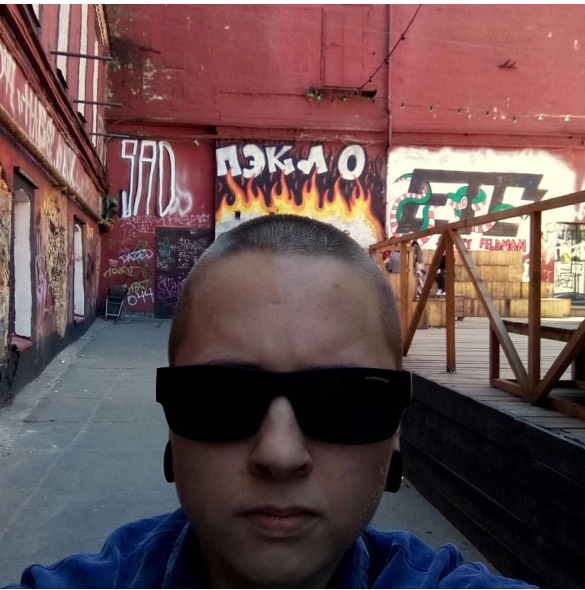
Service in the army
During my service in the army, I became more pragmatic, because I communicate with all kinds of people. I think you have to separate things a bit: this is one thing, that is another – and the “other” isn’t necessarily bad. People start small – at least with themselves, like not throwing cigarette butts on the ground.
We had some interesting conversations. We watched Squid Game, and in the second season there’s a transgender soldier. We watched a few episodes together at the barracks, and the guys tried to comment. I told them: look at what she’s doing – she’s working fine. Really, I haven’t encountered any real hate from them. Maybe I just got lucky with my unit, most people are good.
Once in a while someone said something racist – I spoke up immediately. For example, we were watching a football match: Ukraine vs. France, and there were a lot of Black players on the French team. The guys started saying stuff. I said: “Look at their jerseys – it says ‘No to racism.’ Either don’t like football, or shut up.” And that was it, we kept watching the game.
I don’t need a partnership, I want marriage. But even a partnership would already be like, “oh, well, thank you.” Right now, I don’t see the conditions for it. They definitely won’t bring it up before the elections – this topic is more for speculation than real action. Polls show less than half the population would support it.
But it would be nice. I’m 31, in my third year of service in the army – it would be really great if they did it. After that, you could even feel a bit of love for the modern Ukrainian community. I don’t think about it much because it feels very distant from me. Back when I worked at Insight, it was a top priority – knowing everything, keeping track of everything, going to every protest. Now my work is here, and I think that’s fair – just as a responsibility toward Ukrainian citizens.
There’s been decades of research, statistics – it could have been done by now.
There’s a lot of injustice, but I don’t have time to think about it right now. You have to stay alert and keep going, otherwise, you wouldn’t survive a week at the position.
Some of my comrades know I’m a lesbian – those who follow me on Instagram. There are very few of them, but our commander is a woman. We served together back in 2023, she was a soldier then. She knows my life from Instagram, and has for a long time. She knows I’m a normal person, a responsible soldier. That’s it. We just do our job. If I need to meet my girlfriend or take a day off, she’ll let me. I’m a fighter, and it’s important for her that I function properly. Even homophobic commanders need to get it: the main thing is that a soldier does their tasks, not that they’re distracted by personal stuff.
I have friends in special units – some are gay, some are regular straight guys, but they support us. Just normal people, they don’t hate others.
In units with alpha-type soldiers, they don’t talk about this. I don’t serve in those units, but they exist, and there are many of them. The fighting spirit is based on masculine, traditional standards of the ‘defender’. That’s the army. And no one says “I’m gay” in those units.
We just need more rights for people. It doesn’t matter if they’re right-wing or left-wing – sexuality doesn’t define a person. Both right-wing and left-wing people can be terrible.
There are few military coming-outs. I know a trans woman in the army – if she came out, her life there would be awful. It’s a huge burden.
 Queer War Archive