

I have always been confused and fascinated by the sacred but surprisingly earthly archetype of the mother, one of whose strongest manifestations is self-sacrifice. Child and mother are inextricably linked and do not exist without each other, alive or dead.
h

To keep warm, 2024 oil on canvas
The miracle of codependence, which provokes real heroism, and is never recognized enough. I once read that during the tragedy in Babyn Yar, mothers threw babies at the feet of soldiers to save them. Of course, it was hopeless. During the war, when the threat to the already fragile life of the child becomes absolute, the mother’s only desire and goal is to protect and save, regardless of her own feelings and needs. To give the last possible warmth.
g

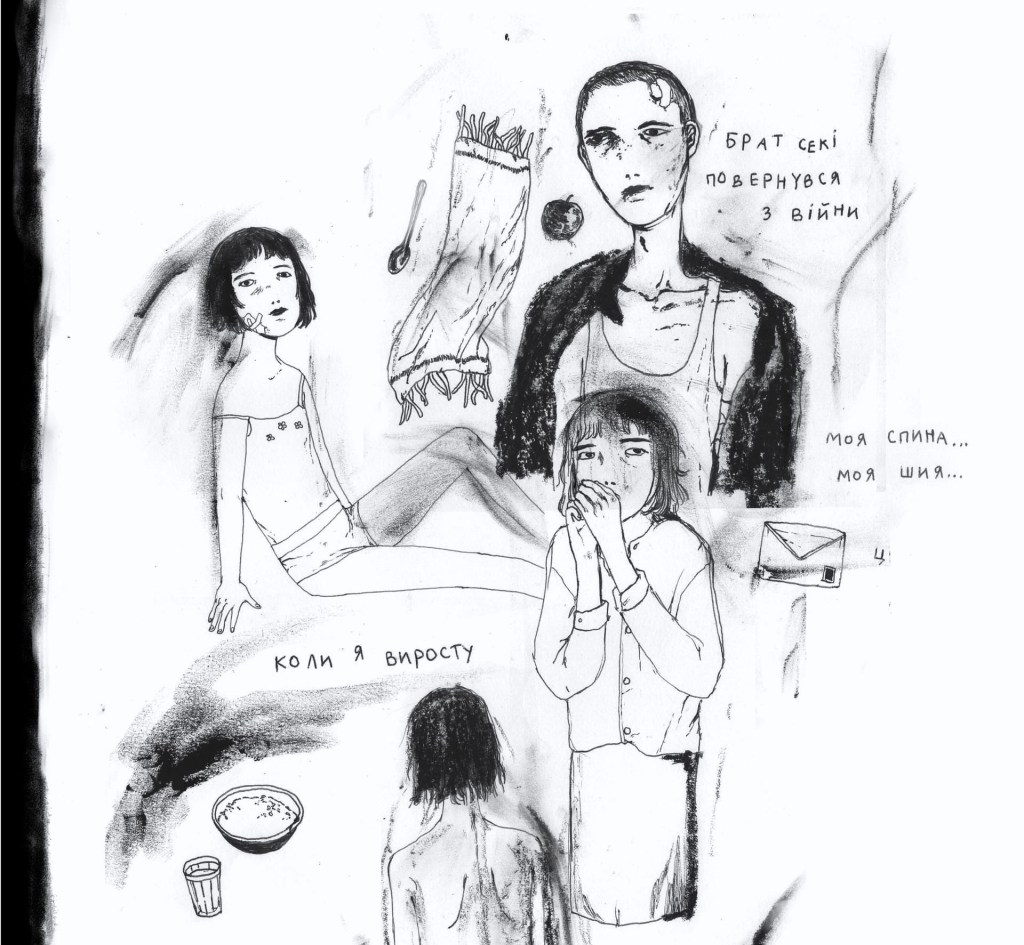
Japanese Lullaby, 2020
G
You see, before the war came, I thought about it all the time. I tried to imagine it, associated civilian sorrows, wrote and drew, felt a quiet presence on the temples and in the air: so called, the memory of the earth. It goes deep into the soil, settles on your hands, never disappears and knows no respite, “here” or “there.” My anxious fascination was not reinforced by political reality, but by the inconsolable breath of fate. An eternal cycle of narratives: not preparation, just the weaving of a personal myth and the exploration of a social one. It grew and multiplied through hyperbolized and obsolete images that had already been studied but never fully comprehended without empirical experience.
K
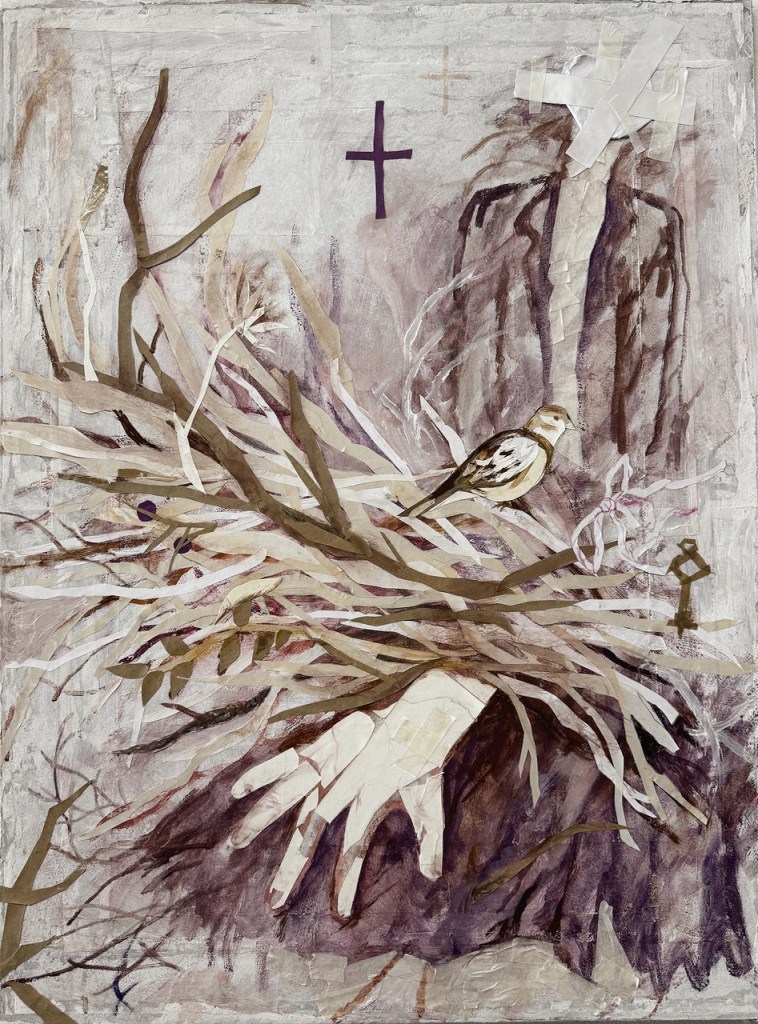
Quiet days breathe in grief, 2024 mixed media on canvas
When the war became a daily occurrence and its face turned out to be completely different from the imaginary one, I felt ashamed. I didn’t know what I could say, what rights I have or whether words even make sense facing the daily dictatorship of suffering and death. But over the years I began to realize that deconstructing the facade cannot change the core, and each of us is a witness. In the archetypes I depict I find the necessary connection with the present, the counteraction to derealization, the inability to accept reality. War feeds on and overgrows with fictions, illusions, romance, memories and evidence, lies with the imprint of truth and the presentation of individual rare cases as common. Image. Although each tragedy is unique and should be considered factually and separately, it complements and branches the plaiting of the continuous, permanent, human. Hunger and destruction do not change attire, and existence is inseparable from the myth of it.
H
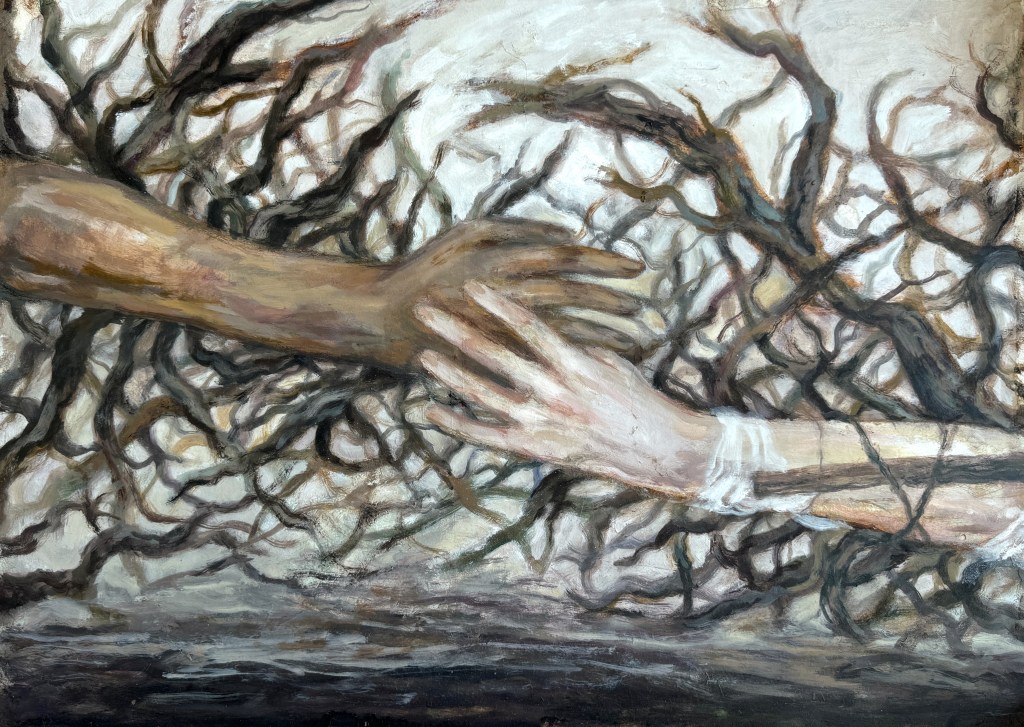
Touch, 2024 oil on board
h
An allusion to the popular heraldic, ancient symbol of a handshake that demonstrates solidarity and mutual aid. When the Apocalypse comes, it turns into a desperate rush, albeit hopeless, but painfully sentimental, a fatalistic act of human unity. The need to feel the tender, trembling touch of someone else’s skin. Between deaf loneliness and jumping into the abyss, real or woven by the psyche.
H
Pawlo Dubinin
(born in 2002) is a self-taught artist and painter from Sumy, Ukraine. He graduated from Kyiv National I. K. Karpenko-Karyi University of Theatre, Cinema and Television in specialty Filmmaking. Pawlo mostly paints and creates collages from everything he can find. The artist lives in the reality of childhood fears, memories, dreams, obsessions and impulses. He allows sincere, alive things of a small human soul, one of thousands, to exist.
h
 Queer War Archive