

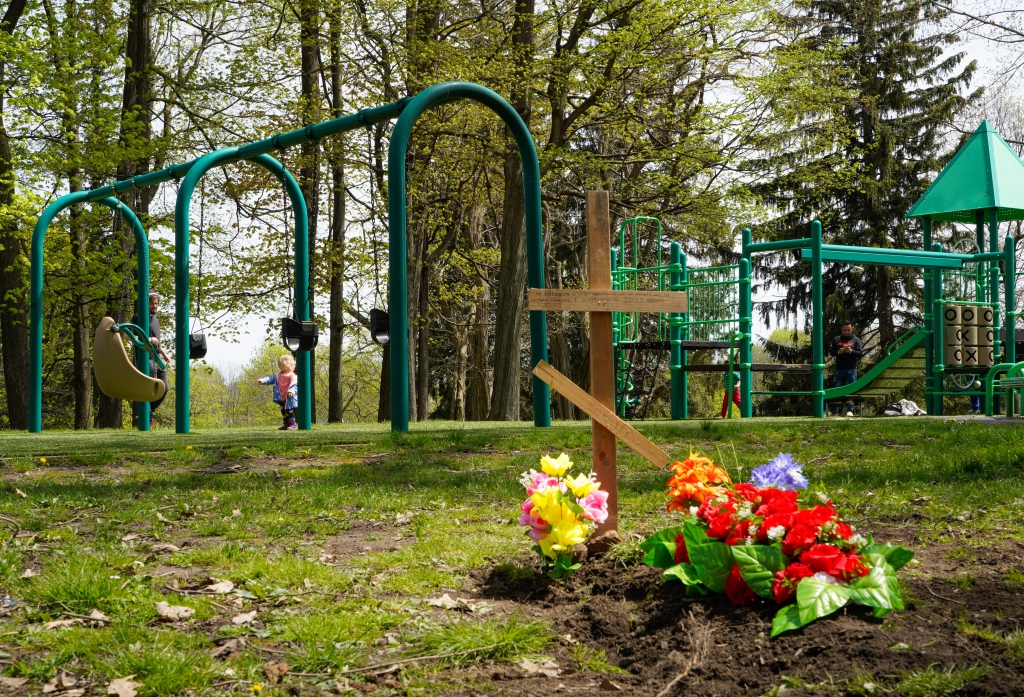
In Syracuse – the earth is clay and full of stones. While digging, I tried to remember what kind of land is beneath the playgrounds of Mariupol. I also thought that diggers are the new heroes of our time. Digging, digging, digging–graves, trenches, shelters. The graves are part of our new landscapes in Ukraine, which, as of now, I have only seen in photos. I tried to dig a grave big enough for my own body. I tried to dig as fast as possible, imagining that it was the only time I had to bury a loved one before the next shelling. I think people dug graves while shelling was going on.
I thought about how I would decide what materials to use for the tombstone: what I would write the text on and what I would write in the text. What is better – a cross made of a piece of plinth and parquet or a branch of a tree and a piece of plastic? This gesture is part of my project “Digging and Burning”, which, more broadly, is part of my attempt to adapt my body to the new reality. A new reality in which human bodies (not all, but those that the entire civilized world has agreed are an acceptable price for peace and security) lose value, cease to be something worth saving at all costs, and, in fact, cease to be human bodies, turn into material. The world can watch death in real time, death is streamed online. In this new reality, I am not capable of theorizing or subtle conceptualizations. There is nothing logical in graves on children’s playgrounds, or, rather, the bodies in these memorials have their own sick logic. According to this sick logic, Ukrainian bodies are the material that feeds the “peace and security” machine. My body is against such peace and security.
Let there be graves in the playgrounds of the entire world; let every civilized citizen, whose life still has value, try to dig a grave for his loved one and answer the questions: where to dig, if there is shooting is everywhere? How deep to dig? How much more valuable is my own life than a dead human body? What to make a cross from? And where to get flowers if “cross” and “flowers” are concepts from a past life that you no longer have?
Oksana Kazmina (July 4, 1984)
www.okazmina.xyz Oksana Kazmina is a Ukrainian Pythoness, archivist, filmmaker, and performer. In 2016, Oksana was a Visiting Assistant Professor of Film Studies at Wesleyan University, Middletown, CT, and is currently an MFA candidate at Syracuse University. Since 2015, Oksana has been working on her debut feature “Underwater,” which registers different aspects of the life and work of four Ukrainian artists, including herself.
Just before the full-scale invasion of Ukraine, Oksana had started series of performative walks/lectures, “Contemporary History of Ukraine,” and bio-dairies, “Dead/ly Landscapes or I Myself Should Become All Places I Loved.” These projects map Oksana’s main interests and practices starting from 2015
 Queer War Archive