

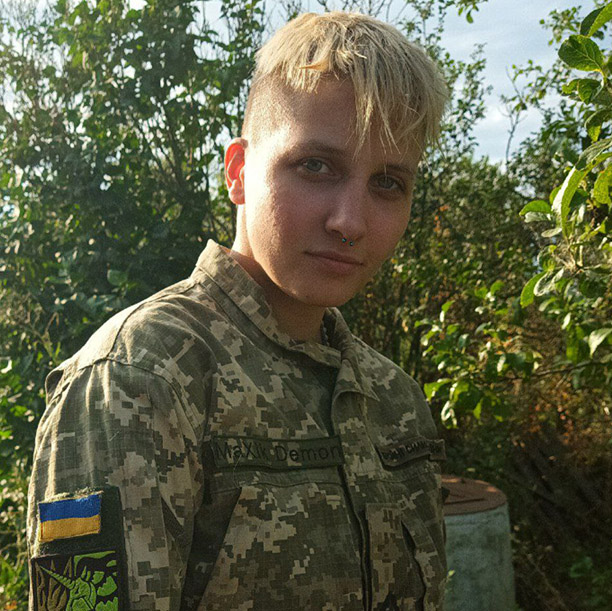
“-It’s about LGBTQIA+ stuff. – Are you trying to give me a heart attack?!”
I’ve noticed that people have become more or less tolerant towards the LGBTQIA+ community, and it’s incredibly heartening. Perhaps, because the LGBTQIA+ community has become more visible in the war as LGBTQIA+ members are serving in the army. Maybe that helped change people’s minds.
People don’t want to perceive LGBTQIA+ as a normal phenomenon. How do you convey this to people? It’s a complex question. You have to constantly explain that it’s okay. I was open before the war too. On all social media, I refer to myself in the masculine gender. I don’t hide it, but I don’t promote it either.
I told my mum that I’ll have an interview on TSN (a TV channel). She said, “Awesome, unbelievable.” I said, “It’s about LGBTQIA+ stuff.” And my comrades even helped me articulate what I wanted to say on air. It was unexpected and nice. But mother was like, “Are you trying to give me a heart attack?” I tell her, “Sorry, life is unpredictable.” I put my parents in front of the fact. I am who I am, whether you like it or not. But in the end, everyone supported me. Yet, my mom keeps going, “When will you get married? When will there be grandchildren?” I wish people would start accepting us.
The LGBTQ+ community does not have the same rights as heterosexual people, even though everyone serves equally during the war. For example, LGBTQ+ individuals wouldn’t be able to visit their partner who is in the intensive care unit or make decisions on behalf of their partner (shared property, children, etc.) if they are unable to due to their physical condition. This list could go on.
How do you feel in your military unit?
Well, in general, my comrades react normally to me. But there are a lot of jokes if this topic is brought up at all. They support me. I am incredibly grateful for life that I am among those people who understand me. When I was just starting my service, there was a moment when the commander didn’t perceive me adequately. But now everyone understands me in my unit.
I don’t force anyone to address me as “he” and “Max.” They refer to me the way they perceive me. I refer to myself in the masculine gender. Self-acceptance is crucial for me.
In the unit, they call me Max. The political officer came to me and asked how I prefer to be addressed. Everyone hears that I refer to myself in the masculine gender. And the platoon commander gave me the call sign Max.
What annoys you?
Firstly, it’s the biased attitude of politicians towards the LGBTQIA+ community. There is an opinion that your LGBTQIA+ affiliation affects the quality of performing duties. And these stereotypes that being LGBTIA+ is a disease, that you can get infected with it. I’ve encountered these stereotypes all my life. That it’s wrong for me to love a girl. Maybe it’s wrong for someone, but I didn’t choose this; I can’t change it. These are my feelings which live as long as I do.
Registered civil partnership for LGBTQIA+
This bill * is necessary because I want to have a partner too, so that we can register our relationship. So that it’s not just “dating” but «being together for life». I can’t do without relationships. And until I register them, it won’t count as okay for me. It matters to me who’s with me, regardless of the circumstances. But still, I want to get down on one knee, open a little box with a ring, give flowers, and propose to register our relationship. I find it mega-romantic.
*At the state level, the law on registered partnerships in Ukraine has been under discussion since 2015. However, it was during the war that a plan of action for the implementation of the National Human Rights Strategy for 2021-2023 was agreed upon. As part of this, as of December 2023, the introduction of the institution of registered civil partnership, including for same-sex couples, has been approved.
 Queer War Archive