

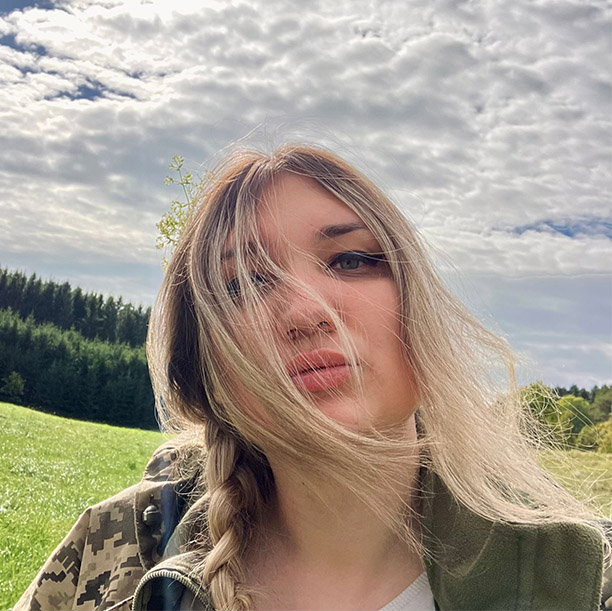
Gender distribution of roles in the army
I am in the army. I am mobilized. Before that, I served in volunteer battalions to a limited extent. I worked as a volunteer. It was self-defense. Nothing interesting, to be honest. I was a medic. I was the only one in the battalion… Yes. And always the only girl in the company. It was hard. “You still have to give birth and all that.” They don’t let me go to combat. Harassment. This is the army.
How do you fight back?
I don’t. Sometimes I just run away as far as I can. Sometimes I complain. But then… It’s better not to complain. It’s a bad idea. You will be punished in the end. Who is easier to punish? A dozen guys or one girl? The logic is simple. It is even a shame to punish the boys, they are fighting. The logic is simple. The war. The army. There are priorities. It is better to go somewhere for a while.
I once did a coming out. I was beaten up. I was transferred to another unit. I don’t do any more comming outs. I advise you not to do it.
In the army, there are two genders – female and male. The female is in the kitchen, and the male is in the trenches. Everyone is forced, at least verbally, to agree with that. I disagree. I’m always eager to go to the front, but not very successfully.
Guys decide everything. And in no case should anyone be told that you are a trans girl, that you are gay. For example, Viktor Pylypenko is okay because he is in the 72nd Brigade. This is an adequate brigade with normal people. And there are brigades like 54 or 53, where if you say you are gay, you will definitely be beaten. It all depends on the military unit.
In the army, I was always supported as a girl, but always hated as a trans girl. I was forced to delete my profiles on social networks by my commanders. They told me not to tell anyone that I was a trans girl. I didn’t delete them, of course, but I probably should have. But it’s okay, I don’t regret it. I was told to come out because my social media gave me away more than my voice or chin.
I have partially closed and partially open social networks. I think they know in my unit, but they keep quiet. As long as I am treated as a girl, everything is fine. But when they start treating me as a trans person, real problems begin. That’s why I try to avoid this topic.
How do you ensure your safety in the army?
I don’t. If I am harassed, there is nothing I can do. If I complain, it’s my fault. If I don’t complain, I’m guilty too.
Status of transgender individuals in the military
In the American army, they are very strict about this. There, girls have to twist their hair into a bun in exactly the same way. And for the Marines, the bun has to have the same diameter. It’s fanaticism. In the U.S. army, they wanted to ban transgender people because they don’t conform to the norms. I do, but many others don’t. It depends on the luck of the draw. They once banned transgender people in the U.S. army, then allowed them again. But no one controls transgender individuals in the Ukrainian army. It has to be done every morning, grooming according to the regulations. Then a sergeant can come up to you and say, “Your hair is not done correctly. Fix it.” There’s no such thing in war. There’s no time for dressing up, uniforms, and such. In America, they have uniformity. But towards lesbians and gays, there’s an adequate attitude there, in most parts. While in our case, it’s in the minority parts where there’s an adequate attitude. There’s a difference. In the Ukrainian army, transgender individuals are completely banned. By law, a transgender person cannot serve. But in a full-scale war, they take anyone they can get. We have work to do. The American army is 10 times better. They have all the equipment and social insurance.
Transition in Ukraine
I underwent transition in Ukraine, all at my own expense. It’s very expensive. I could have paid four times more for a better result. I could have looked like Barbie. That would have been cool even though nobody would have let me go to the front. But I would be satisfied with myself. However, it’s expensive, not worth it. It can cost 400 thousand hryvnias (around 10 000 euro). And that’s still an average price. Clearly, I spent much less. I have a husband in the Netherlands. And I have a daughter. We started our relationship three years ago.
Standardization in the modern military vs. historical diversity
It’s tough, but there’s progress. In the army, there’s this thing called uniformity, everyone has to be the same. And women for example stand out externally – long hair, breasts, curves, height – so they aren’t desirable here. And about the LGBTQIA+, they’re completely silent. As I was explained, there’s the concept of uniformity. And that’s the Army’s catch. Do I like it? Not really. It’s a doctrine. The uniform has to be the same, but in practice, it’s complete nonsense because, everyone is so different and unique. I think the uniform is purely a feature of the Soviet Union. Before the USSR, this “uniformity” was in the Russian army. In the Polish army, before the fall of the First Polish-Lithuanian Commonwealth, there was no uniform. Every knight was unique. Yes, they marched in columns, but the equipment was unique, the weapons, the appearance. Uniformity appeared in the 17th century, and they still don’t want to give it up. On the front lines, everyone is different, each with their own camouflage, their own uniform, their own hairstyle even though they are supposed to be the same. There are Christians, there are Muslims. There are those with tattoos. It’s prohibited by regulations, but everyone has them.
 Queer War Archive