

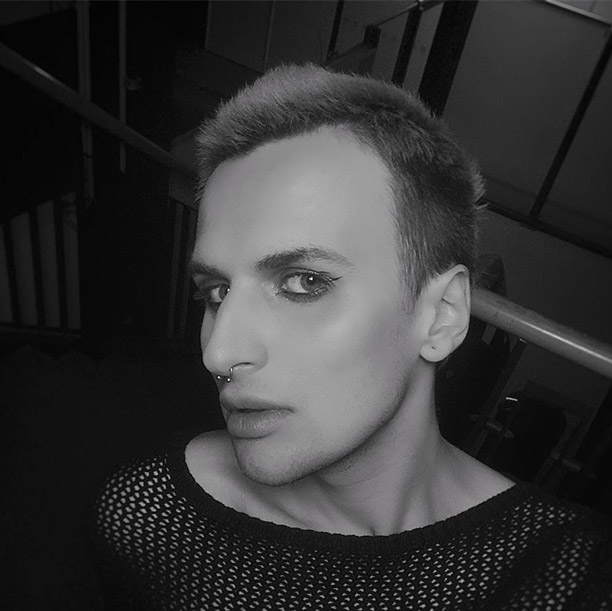
This interview took place a day before Helen was granted permission to leave the army (July 2023). According to Ukrainian wartime legislation, soldiers aren’t entitled to be issued a medical certificate F.64.0 (diagnosis: ‘Gender Dysphoria’). She’d been struggling to get this for months, and during the interview, she was deeply upset. The certificate was needed for her to leave the army and continue hormone therapy officially, not undercover. Helen did manage to leave the army in the end. However, it only became possible as a result of her being diagnosed with ‘anxiety-depressive disorder’ by a military doctor, as opposed to her receiving the desired F.64.0 certificate. Today, Helen resides in Berlin.
What is your situation with the transition now?
I’m on hormones, undergoing hormone therapy. It’s been three months already. In Ukraine, there are organizations that provide hormones for free.
Transition during the wartime: legal issues
I will speak about my personal problem that I am facing. Since I started transitioning whilst serving in the army, during martial law, I faced such a problem that the military psychiatrist refused to see me at all. He said, “I have nothing against it, but it’s not for me, it’s not for me.” But who else, if not him? Okay, I went to a civilian psychiatrist, to a clinic where they can issue a certificate F64 “Gender Dysphoria” or “Transnender” so that later I could go to an endocrinologist with this certificate and start taking hormones. That is, to start the transition itself. A civilian psychiatrist also refused me, citing the fact that they are not authorized to serve military personnel. It’s a vicious circle, really. Once I get an F64, as far as I know, I will be able to get out of military service. But I can’t get an F64 in any way. I need it to start legal hormone therapy. I started it, let’s say, privately. With a private endocrinologist. The state discriminates against us in this regard, believing that this cannot happen at all. That some person, or some military man, would suddenly want to change his gender during his service. To start this transition process.
Negative experience
I serve at the training ground. This is not a unit. We live in tents.
I am generally not very satisfied with my communication with colleagues. I find it rather rude. I am not satisfied with living with men. I do not have any personal space. I am offended by questions about my genitals. The point of my coming out was to make everyone understand who I am once and for all. And so that there would be no more questions. How to address me, in what way. But people specifically address me by my old name and use the masculine pronoun to offend me, misgendering me.
And this is done every time, without forgetting about my genitals. They talk about how I look. They tell me I am a man. I also suffer from dysphoria. I suffer from being there in general. My stay there is a total suffering. My antidepressants don’t help me anymore. I am in despair.
Experiencing unsafety
Unfortunately, my eyes have recently opened to the fact that we live and walk on the same streets with people who consider it normal to decide who should live, who shouldn’t, who can be beaten, and who can’t. There is a significant problem not only with LGBTQIA+ issues, but also with the fact that human rights and freedoms are very inaccessible to the average citizens. I would rather call it a problem of patriarchy. To a greater extent, the streets are filled with many sons of patriarchy, raised and molded into toxic masculinity. They believe it’s up to them to decide what should be and how it should be. We need to work on this. People need to be explained some basics.
The rage and joy of being oneself
I’m a very principled person. I can’t be someone else. I’m unique. I want to live my life, today and tomorrow, because it happens now and in the future. Whether it happens in terrible conditions, in a dreadful environment, or I encounter dreadful things, I want to face all these challenges myself.
Who can help you and how?
There’s a significant nuance to my issue. I understand why organizations that promised to help are not providing assistance and, in general, not even responding. I realize that my case – starting the transition in the army – is unique. In the Ukrainian army, I’m definitely the first. And there’s no law that supports me in this. Organizations understand that they are powerless, and that’s why they don’t even acknowledge my existence. Maybe they’re embarrassed to write to me, to say, “Sorry, we can’t help you.” But they help other people.
 Queer War Archive